

Welcome to the fourth issue of Techtris – a newsletter looking at what’s going on in the world of tech, regulation, and everything around it, and (more importantly) what it all means. I hope you’re enjoying the show so far – if you are, please do think about forwarding it to a friend or signing up for a paid subscription.
The free subscription numbers are ticking up nicely, but I’m still short of enough paying people to make this work in the long run. In a few weeks I plan to make this weekly newsletter paid-only, but I will start to do breaking analysis/insight when it’s relevant and that will stay open to the whole free list.
On with the show!
A stupid game to play

Reality has a sense of timing that would get any decent fiction writer into trouble. Last week, the government launched the incredibly naffly-named “Unicorn Britain” initiative, to try to attract big tech talent to the UK. That very same week, the Competitions and Market Authority (CMA) brought out a report on the proposed $69 billion acquisition of Activision by Microsoft, and came down strongly against it.
Activision is best known as the maker of the blockbuster Call of Duty franchise, and as the owner of Warcraft and Diablo maker Blizzard, while Microsoft is behind the Xbox console series. An obvious concern about a takeover would be something like Microsoft making Call of Duty exclusive to Xbox, freezing out Sony’s PlayStation, and thus damaging competition.
The strange thing is the CMA report (PDF) considered this risk…and dismissed it. The authors found it would not be in Microsoft’s economic interests to restrict Call of Duty to Xbox, and that even if it gave Xbox favourable terms short of exclusivity, that would have little impact on the very competitive console sector.
All of that would seem to be in favour of allowing the acquisition. But the CMA didn’t finish there – instead, they hit on an unusual niche within the wider gaming market: cloud gaming. Cloud gaming is a setup for gaming where instead of downloading a game and running it on your own hardware (your computer or console), the game runs on a remote server and is transmitted to you over the internet.
This in theory could replace the need for advanced consoles with expensive graphics hardware, and make it easier to have Netflix-type models for games. The downside for cloud gaming companies is that they have to do all the processing themselves – which for high-end games and graphics is a lot of processing, and that’s expensive.
The CMA noted that Microsoft has lots of advantages in cloud gaming, and already has 60% to 70% of the cloud gaming market. Because Activision could add to this supposed significant advantage, they have flatly prohibited the takeover. If Microsoft wanted to revise things to try to proceed, they would have to take major action – perhaps selling Call of Duty, or selling all of Activision (but keeping Blizzard), or selling both Activision and Blizzard (this is confusing, but there is a unit inside the company “Activision” called Activision, etc).
Given neither of these companies are British, this is punchy from a UK regulator. But it’s also quite a hard decision to understand. Microsoft might have an edge in cloud gaming, but it’s hardly the only player in cloud computing.
Google has a huge cloud infrastructure and an outsize role in mobile gaming through Android and its store. Amazon is the owner of gaming streaming service Twitch, and is the preeminent supplier of cloud services. Sony has huge infrastructure that could be turned towards cloud gaming, and a huge head start with consoles.
In fact, Google tried to enter the cloud gaming market with the Stadia console, and eventually retreated because it decided it wasn’t worth it. Google was not bullied out of a lucrative market by a monopoly player – it just decided cloud gaming wasn’t ready for primetime. Any one of those companies could re-enter.
As it stands, the UK logic seems to be that because no-one else really wants to bet on cloud gaming, but Microsoft will, it should be prevented from making an acquisition almost entirely unrelated to cloud gaming. This is a bit like banning someone from buying Microsoft because you’re worried about the Surface Pro dominating the laptop market.
The CMA will surely have jumped through endless hoops to make sure its decision-making is watertight and will survive legal challenge – but this ruling on its face is so perverse that some will surely be questioning whether the CMA had a conclusion and worked backwards to find a justification for it.
A surefire sign of just quite how weird all of this is can be seen in today’s Sunday Times, in which several of Microsoft’s cloud gaming rivals – the people who are supposedly being protected by the CMA’s decision – have come out publicly to condemn it as unnecessary. It’s a wild world.
The bizarreness of the situation, though, is hardly going to be encouraging to tech companies that might look to invest in the UK. We can agree that tech regulation matters without just reflexively banning anything tech companies want to do. This feels far too much like the latter than the former.
ALERT ALERT THIS IS AN EMERGENCY ALERT
Relax, it’s actually just a test. The UK’s test of its new emergency alert system seemed to drive everyone far crazier than any routine test of a new system should. The Daily Mail led the charge in advance of the alert, warning it might cause car crashes, panic in stadiums, and more – none of which materialised.
In reality, many of us at 3pm last Sunday heard a brief annoying buzz on our phone, which for some of us was dismissed so quickly we couldn’t actually read the text of the alert (not ideal). For users of the Three network (and networks using its infrastructure) the alert never arrived – more on this later. But even this apparent non-event sparked a series of different conspiracies.
One conspiracy was that the alert was some form of data harvesting. In reality, the government has previously used the text message system to send out alerts during Covid-19 – and these do actually require your phone number to be known (at least by the network sending it), even if it doesn’t need to be tied to your ID.
Emergency alerts are different. In essence, what happens is the government transmits a message to a centralised set of phone masts/control centres for each network. That message is then sent out from phone tower to phone tower, intended to get to every tower within the network – this is the step that failed for Three, for some reason (this is likely Three’s fault, rather than the government’s).
Each phone mast then pushes the alert to every phone that’s currently in its range – based on when it was last pinged by that phone. It doesn’t rely on knowing anything about the device receiving the alert. It doesn’t even need to know your phone number. So by its very design, this could not have been anything to do with data harvesting. (The reason for this architecture is it lets the messages be sent much quicker than the standard two-way systems – which is better for time-sensitive emergencies).
The second conspiracy (I’m leaving aside the out-there “it’s going to activate the vaccine nanobots” stuff, but that did happen too) was if anything even sillier. Absent any real sourcing, Twitter on Monday spontaneously decided that the emergency alert had been conducted by Fujitsu, who in turn had subcontracted it to Infosys – the company founded by Rishi Sunak’s father-in-law, in which his wife is a major shareholder.
As it happens, there was in fact no truth to this, as FullFact helpfully reported. But would it have mattered if there was? There has been cross-party support for a UK emergency alert system since at least 2013, and its rollout predates Rishi Sunak’s premiership. Infosys is a huge corporate IT services provider that works with governments across the world – it is inevitable they will have some involvement with major government IT projects.
The problem comes if they are given special treatment or higher prices – by trying to make every instance in which Infosys is used by the government a scandal, we obscure real ones. The situation highlights the problems of having an ultra-rich prime minister in a country not used to such things, but when we have such real and constant cronyism from the government, it’s pretty woeful to shoot and miss like this.
The media and tech: montagues and capulets?
It’s been a pretty dismal few weeks in digital media. Earlier in the month it was announced that BuzzFeed News will be shuttered (Disclosure: I worked for BuzzFeed News between 2015 and 2017) and most remaining staff will lose their jobs, while this week drastic cuts to FiveThirtyEight were announced by Disney, and VICE shuttered its award-winning VICE World News brand – and these were just the most obvious of the job cuts going.
These newsrooms did not fail because of their staff – or even because of their senior editors. The seeds of their doom were planted during the boom era of the mid-2010s, when they were either acquired or obtained investment at huge valuations.
The media brands were valued as if they were tech companies – something that they could never have hoped to live up to. Producing journalism is a linear enterprise: even if you’re churning out rewrites (which these newsrooms weren’t doing) there are only so many stories each journalist can produce each day. The amount of content rises in a steady relationship with the number of journalists. There’s only so far efficiency can take you.
Tech, meanwhile, relies on exponential growth: the idea is that most things (even a good chunk of moderation) is automated, and so you can grow your users or your output far faster than you grow your staff.
BuzzFeed News and VICE managed to convince investors (in an era of cheap money) that these old laws of gravity didn’t apply – but reality caught up. Trying to continue to justify these valuations meant that the sites were forced to constantly pivot, to look like they were innovating and continuing to be tech, rather than media, properties. It could never have lasted.
The damage done by the confusion of media and tech has deeper roots than this, though: search and social is how the media acquires its audience, but media’s corporate owners feel that both have somehow unfairly stolen their ad dollars (the reality is much more complicated).
Because of years of lobbying for charges to be levied on snippets in search results or on Facebook, big tech has spent years producing reports showing how little value they derive from news (Facebook, for example, says just 3% of posts link to news publishers). The trouble seems to be that as they have produced these briefings for regulators and lawmakers, big tech has come to believe it.
At the newsroom level, Google and Facebook often had friendly relations, to an extent. Google News Initiative brought genuine value (as well as some funding) to newsrooms, while Facebook partnered with news organisations and helped fund events such as the fantastic International Journalism Festival in Perugia.
For Facebook, this era seems to be over entirely, while for Google it looks to be winding down. This is a loss to both parties, but will disproportionately hit us on the media side – for all that we like to deny it, we are reliant on the companies that provide the backbone of online services to reach our audiences. We need big tech more than they need us.
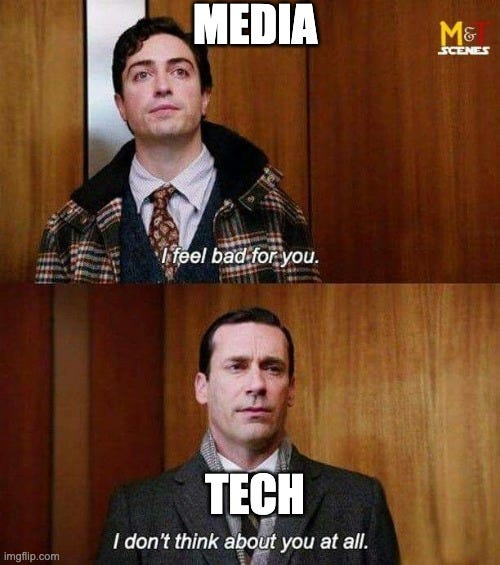
Media trying to pretend it was big tech and should be valued as such ended horribly. Media taking on big tech as if it’s an adversary – rather than a subject that should be covered, a power that should be held to account – will do the same. We really need to normalise relations.
Last-minute tech-and-media bonus
After a few months of doing whatever he can to troll the world’s journalists, Elon Musk has decided to save the media (annoyingly I have to screengrab his tweet because Twitter embeds are still broken):
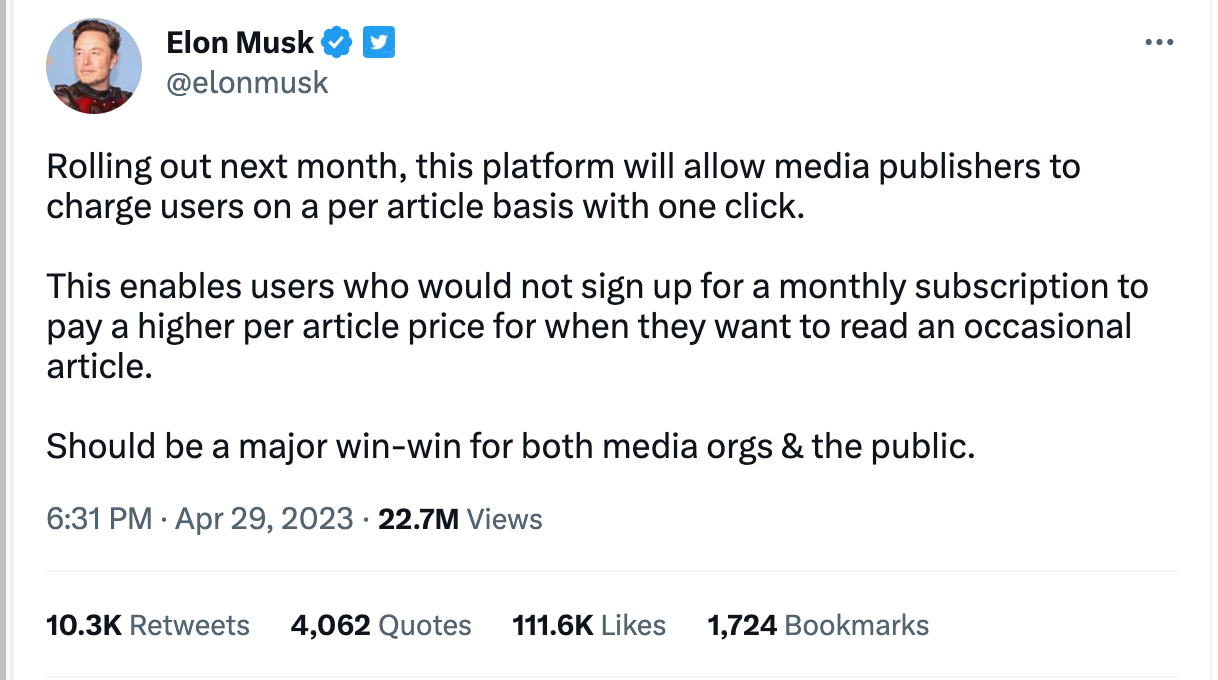
Thanks Elon! Allowing people to pay-per-article is one of the most common “why don’t they just” I ever see on the internet – but it’s not that it hasn’t occurred to big dumb media bosses. It’s that if you’re an actual media company this is a terrible proposal.
Basically, the lifetime value of a new subscriber is often in the hundreds or thousands of dollars to a media company. It is hitting a paywall repeatedly that eventually induces someone to subscribe. Even if most people who hit a paywall will never subscribe, if even a fraction do, it’s worth it.
So why not try to let a few of the people who would never subscribe, but would pay for one article, do so? The issue is that some people who would otherwise subscribe will buy one article instead. If you expected $100 a year from a subscriber and charge 20c for an article, that means if even one potential subscriber instead buys an article, you’d need 499 others to buy it too to break even.
The economics of this just don’t work for publishers. At all. Elon is not the first person to offer this service, and his will fail just like the others did before it (one approach that might have worked is sharing some of the $8 a month for a limited paywall break, divided based on usage). Pay-per-article only works when the price is much higher than most users would ever pay, and it barely works even then.
Here’s a longer 2020 piece I wrote for CJR on this exact topic.
In the meantime, I get no micropayments at all! So, y’know, if you did fancy subscribing (or upgrading), you have read this far already…
Tech titbits:
Off the back of last week’s “internexit” post, the problems with the Online Safety Bill continue to mount – Wikipedia is the latest to say it will risk being banned from the UK rather than comply with the legislation.
Thomas Rid has discovered a nasty way in which your own Airpods could be used to stalk you – Apple needs to find a fix for this.
Rest of World has a genuinely alarming piece about the real-world consequences of AI translation that are already happening.
Even as Twitter degrades in front of our eyes, I have yet to be taken with any of the rivals. But Ryan Broderick’s Substack this week does make Bluesky sound quite fun.
On the subject of Twitter degradation, New York’s, MTA has quit Twitter, citing its unreliability. These will keep on coming.
Elizabeth Holmes won’t be going to prison this month, after all. Huh.
The editor that ran the bizarre ChatGPT-generated ‘interview’ with Michael Schumacher has been fired. And rightly so!
And finally…dog Jesus

For reasons I can’t quite remember, I had cause to ask the AI art generator Midjourney to generate an image of the crucifixion of Christ, but with Christ as a dog (it was a somewhat strange WhatsApp group chat).
This ran into a few problems initially as “crucifixion” is – for good reasons – a banned term for the art generator, but it did eventually accept the ascension of Christ as a dog as an acceptable term. The result is above and I find it oddly fascinating.
Of course, it portrays definitionally The Goodest Boy, but it shows a lot about the generation process: despite the banned “crucifixion” term, our dog is in the right pose for that. Note also the artifacting on the left paw: the AI on one level is ‘wanting’ to make a paw, but also knows that a lot of the source material it’s looking at are hands. As a result it’s compromised between the two.
Most interesting though is the fur – it’s clearly modelled on a flowing robe, rather than on dog fur. The hybrid effect is quite uncanny valley. AI ‘art’ isn’t the result of creation – it’s essentially aggregation with randomisation and error. I thought this image showed that up better than most. I also wanted to throw Him a stick.