

I should have known better. I do know better. And yet, thanks to a thread posted on the evening of Good Friday I managed to do what no sane person should ever do: I made myself the main character of Bluesky. The first post in the thread has 870 replies and 1,044 quote posts. That’s never a good sign. The subject that had proved so contentious? Bluesky’s user numbers.
Don’t panic: this isn’t a post about “left-wing intolerance”, “why I’m going back to X” and it’s certainly not a “why I left the left” article either. Instead, it’s an attempt to set out the Bluesky user number situation a bit more clearly and calmly, and to say why it matters. There’s a bit of discussion about why the numbers are where they are, but that’s safely lower down in the post, I promise.
The problem(s) with the original post
The easiest place to start is with the chart I embedded in my original post:
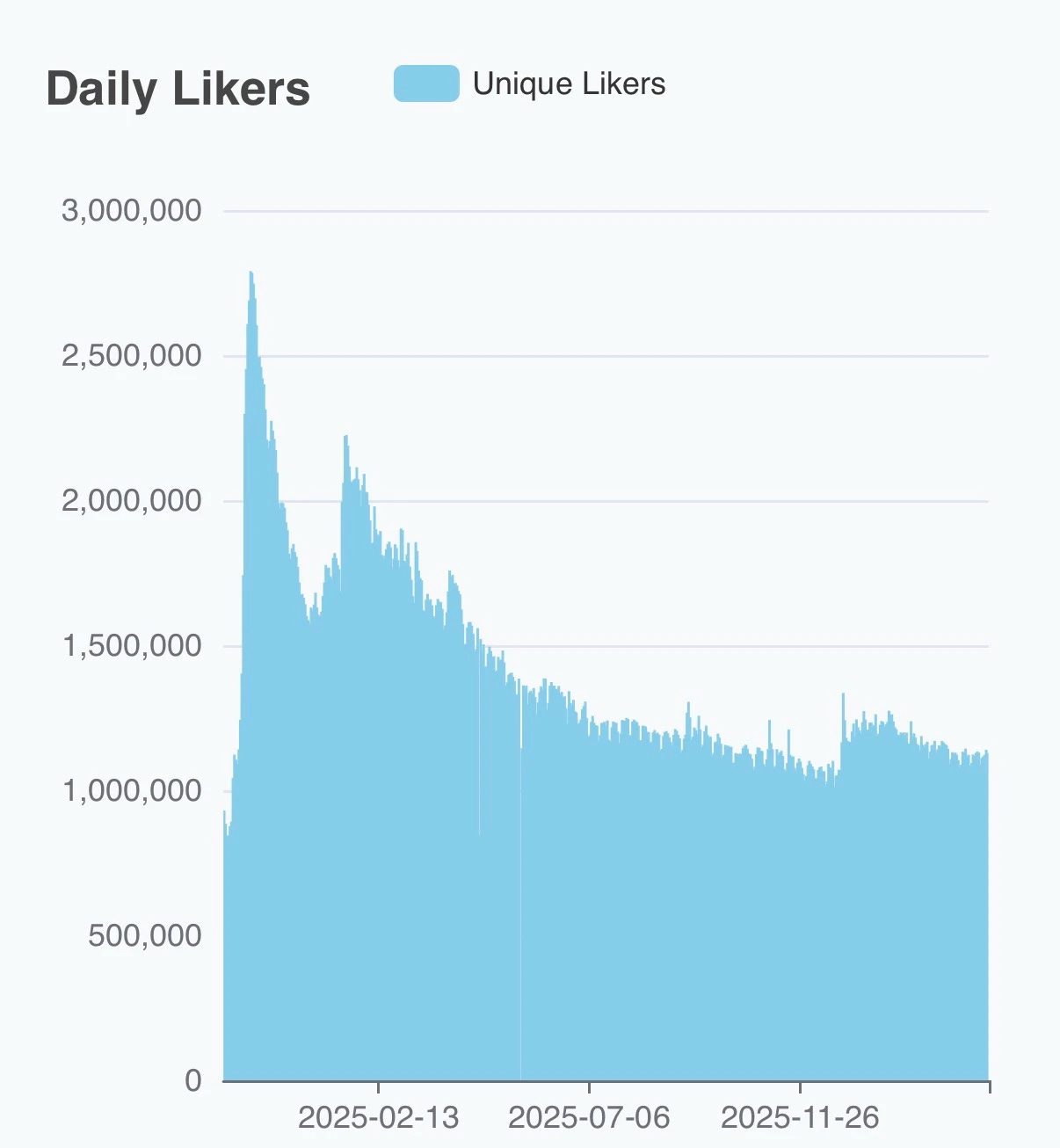
I used this chart to argue that “The network is shrinking, not growing. It's shrinking a lot: only about 1.1m people a day even like a post. This time last year it was 1.6m”. This proved contentious for a host of reasons.
Lots of people accused me of cherry-picking my data, assuming that I was going from the peak of the graph to today, whereas in reality I was checking this week against the same week 12 months previously, which was already well down from that short-lived spike. But given the post didn’t make it particularly clear what I was doing, it’s a reasonable critique.
The other most frequent criticism was that I didn’t include the data since Bluesky was founded – and before that spike, user numbers were much lower. User numbers are certainly much higher than they were in 2023, as people correctly noted. Including those old numbers might give more context, but as it zooms the graph out it also makes it harder to read. More than that, the fact the social network was growing two years ago is not material to whether or not is has shrunk over the last year.
The third critique was why I was using “daily likers” as a measure, and whether that is meaningful. The reality is there’s no one perfect metric, but for Bluesky we have access to data on how many unique individuals like a post every day, and how many unique people post every day, helpfully aggregated at https://bsky.jazco.dev/stats.
Not everyone is a poster. Most successful social networks obey power rules: most views accumulate to a tiny subset of power users. There’s then a wider pool of people who post frequently but only to a small audience, and then a wider still group of people who rarely, if ever, post but instead act as a largely passive audience.
Including “likers” as well as “posters” is a way to try to grab the largest possible proxy of Bluesky’s audience. Yes, there will be some fraction of people who read Bluesky daily but never interact with a post, but it will probably be proportionate to the “likers”. Anyway, what follows is an attempt to get some more concrete numbers to look at.
Bluesky: the numbers
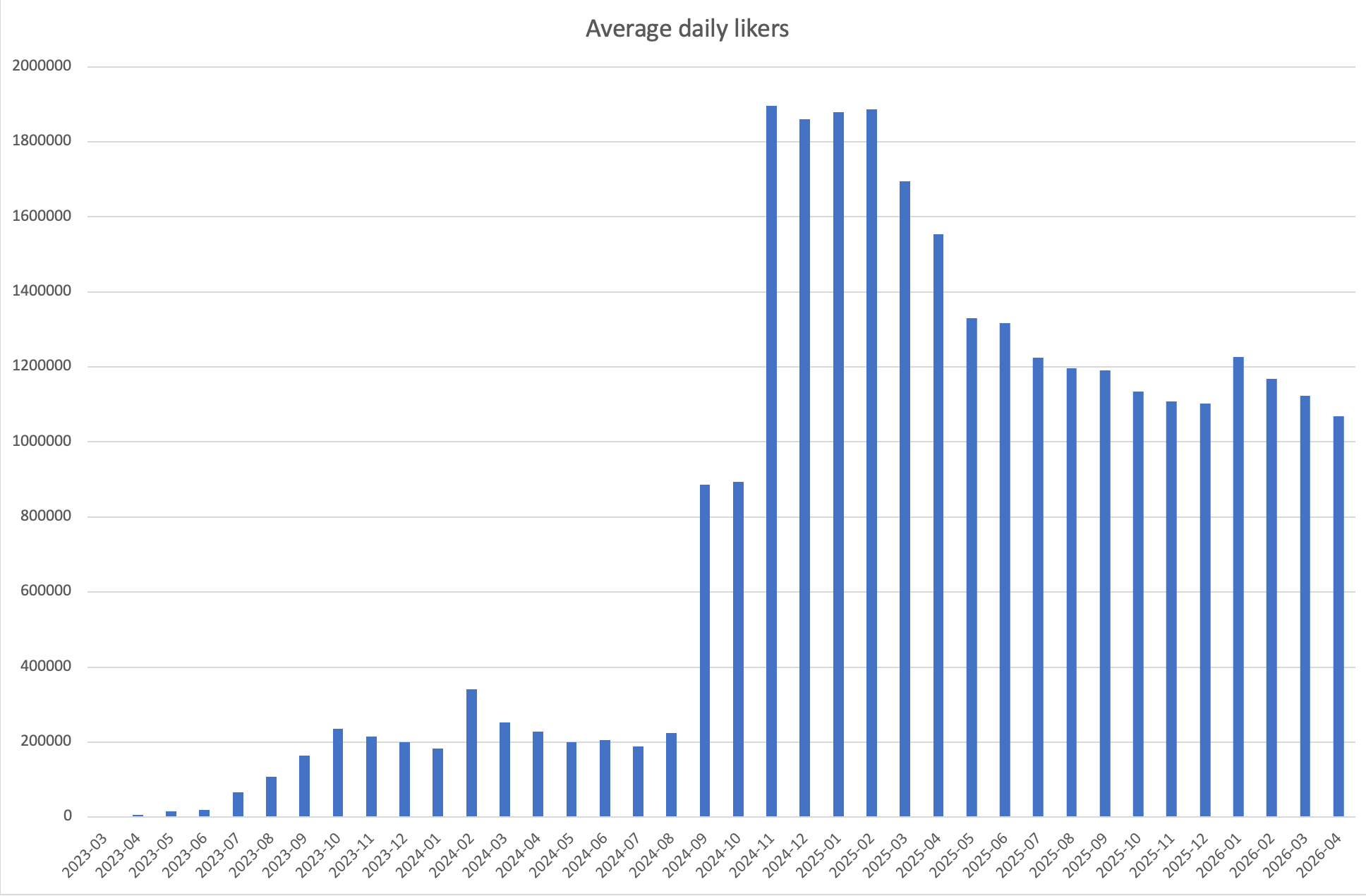
One issue with the chart I used in the original post is that it’s quite noisy: posting follows a weekly pattern, and rises and falls through it. For looking at long-term trends, things are easier to see without that.
To make things simpler, I’ve averaged daily likers and daily posts by month (this is a simple mean: adding up the daily totals and dividing them by the number of days in that month). I’ve also included the full dataset since Bluesky was established, so people can’t complain I have cherry-picked.
Here’s what that looks like for daily likers:
And here’s what it looks like for daily posters:
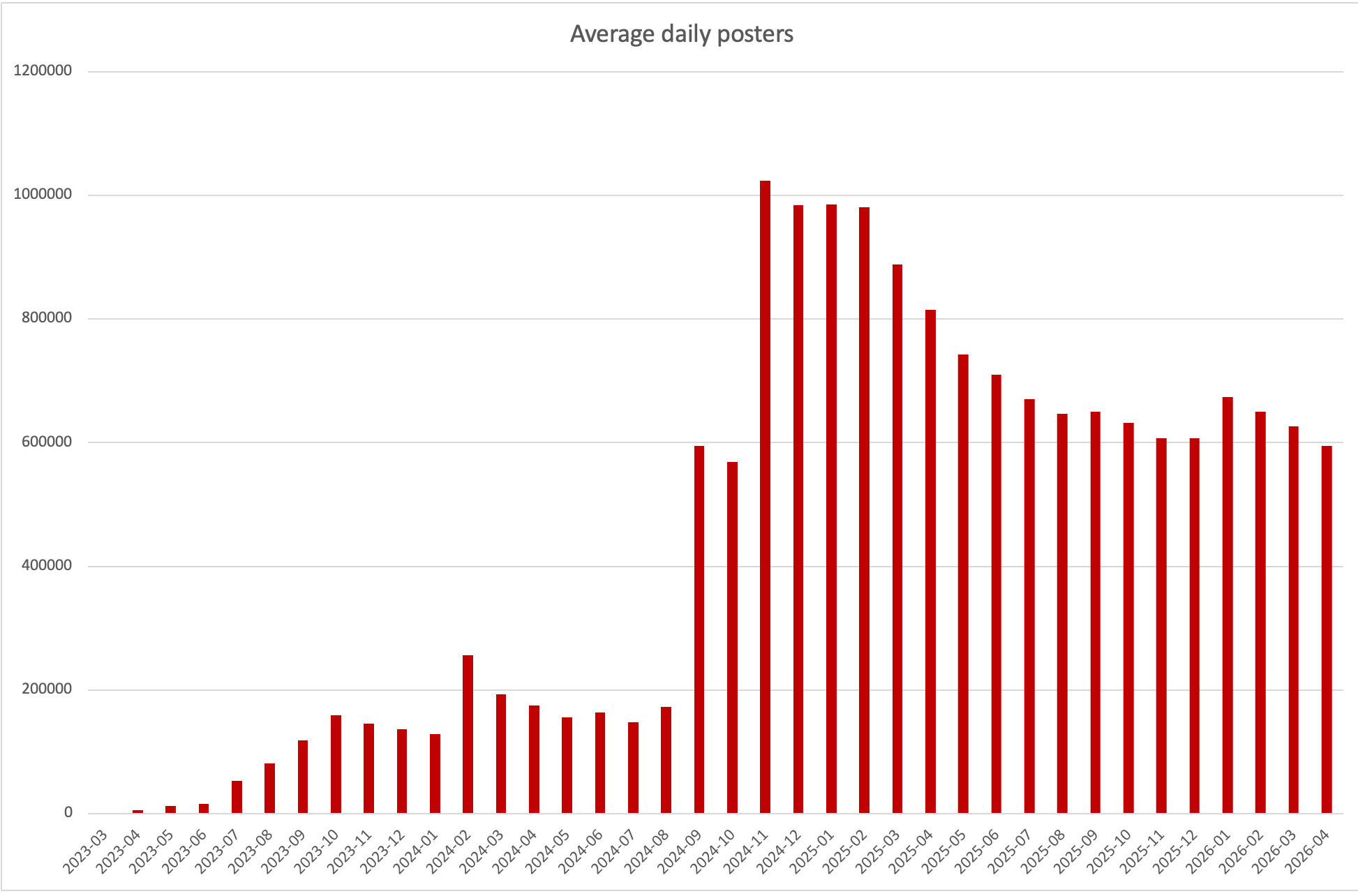
I think it is very hard to spin a positive story out of either of these graphs. Bluesky had its big injection of new users after Donald Trump’s second election win, and in the first months of his presidency, when Elon Musk was most active in Doge. But even by March 2025, this was dropping back fairly precipitously.
It’s clearer on a chart showing likers and posters together:
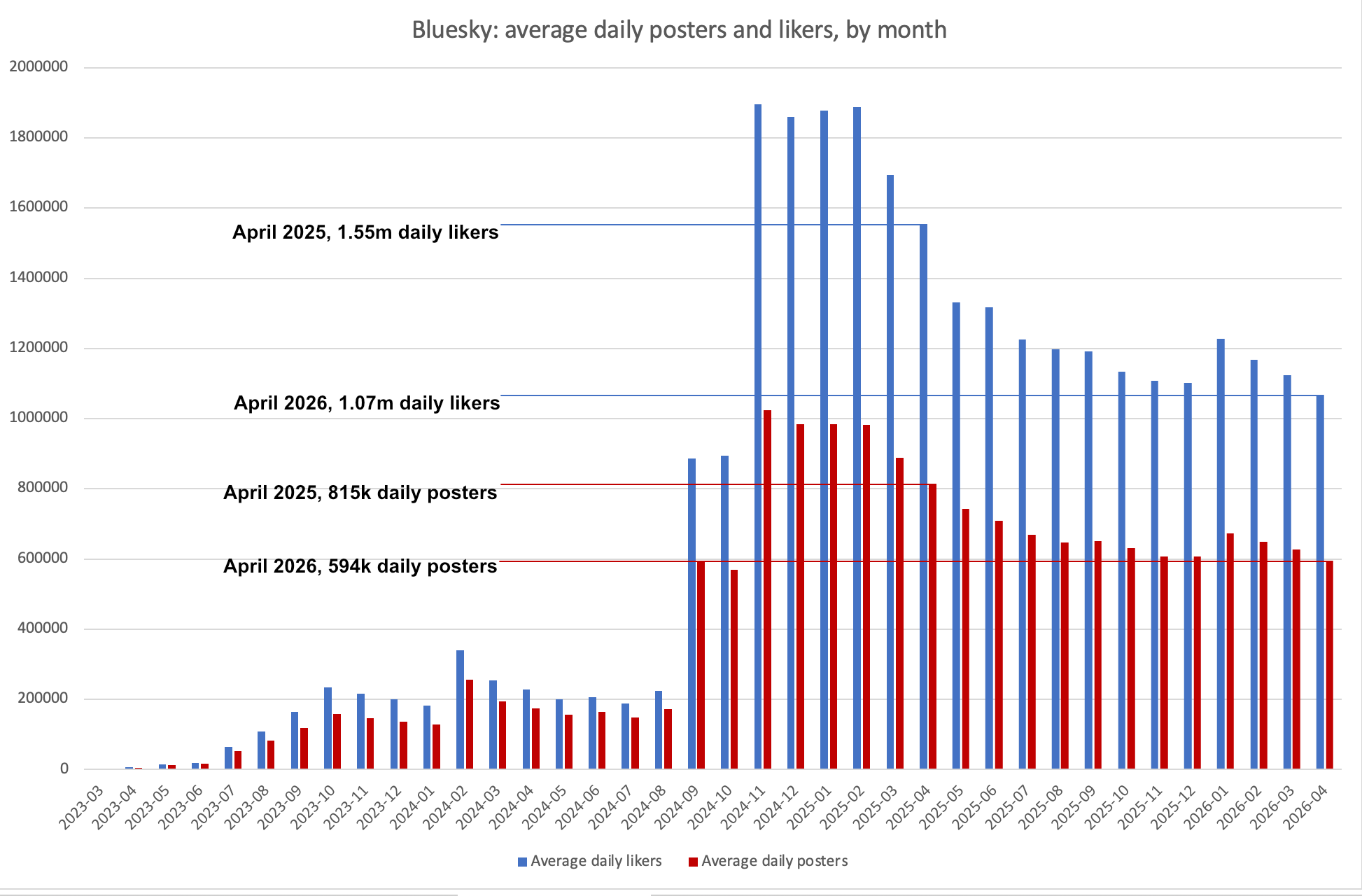
In the first few days of April 2026, average daily posters had fallen to the level of September 2024 – handing back everything the site had gained since Trump’s election win. The likers figure that I used in the original post was actually the more generous metric to Bluesky, as it is at least still higher than during the Biden years.
There is no good faith reading of these numbers that tells you Bluesky is growing, and even to claim its numbers are stable is largely cope. The Grok nudifying scandal of January 2026 caused another spike in Bluesky users, but this one was much smaller than those that went before – and within just three months, it had handed back all of those gains. Absent that small spike, Bluesky has on average, since early 2025, been losing about 4% of likers and 5% of posters every month.
Why should I care whether Bluesky grows?
This is the better question about this stuff: most of us aren’t technology investors. We just want a social network we can use, and which ideally isn’t full of fascists, trolls, and bots. Bluesky’s small size can feel like a bonus against that backdrop: for many of its current users, the network feels fine as it is. Why worry about it growing? I’m getting what I need from it now.
The problem is monetisation: Bluesky costs a lot of money to run, and at present the bills are being paid by investors. They don’t do this out of the goodness of their hearts. They do so in the hope of making vastly more money later. Generally, investors will be happy to subsidise the losses of a company if it is growing, especially if it is growing fast.
Whether or not you agree Bluesky is shrinking, we can surely certainly agree it’s not growing. That means at some point, possibly quite close in the future, investors will stop paying for it.
In theory, that could be okay if Bluesky could cover its own costs. The issue is that at present it is not monetised at all. It has no adverts and no subscription model. Its a nice idea to think that maybe Bluesky could start charging subscriptions, make enough money to cover its costs, and stay relatively small – but in practice, its user base is just too small to monetise in this way.
If Bluesky was 10x bigger than it is now, it would still be a tiny social network, and still probably too small to survive off the revenues it could raise. Small might be beautiful, but in the internet era it’s generally not practical. If we want Bluesky to last, it needs to grow – either so investors keep paying for it, or so that it could raise enough revenue from users to cover costs. Both methods require growth. “Bluesky stays as it is” will only work for a limited period of time.
Is this a “Bluesky problem”?
People have suggested that Bluesky’s failure to grow might be less to do with the product itself, or even Bluesky’s culture and user base, but rather a reflection of much broader online trends. Social media seems to be hitting a plateau, and text-based social networks even more so.
This might well be true, but in some ways it’s not especially important: Bluesky is so much smaller than its ‘rivals’ that it should, in theory, be able to buck the tide. On their mobile apps alone, Threads had an estimated 141 million daily active users in January 2026, while X has 125 million.
That’s tiny versus the scale of Instagram, TikTok or YouTube, but it’s huge compared to Bluesky. There is still a huge pool of people using text-based social media daily, and Bluesky is appealing to less than 1% of them. That’s particularly disturbing given that Threads is mostly full of AI slop and out-of-date memes, and X is quite often a far-right hellhole. They’re as bad as they are and they are still winning. Something feels wrong with that picture, no?
I don’t care if Bluesky dies, though, I’ll just go somewhere else
Sure…but where? Communities take time to build, and people have to have faith it’s worth the effort. Some of those people are the ones who put the money in, but it’s also the people who make the content – and the power users of text-based social networks have bounced around an awful lot already.
There isn’t a huge set of new startup social networks around. If you’re just looking to troll the libs and write “Bames Jall” to your 70 followers, that might not matter. But for people who use social for their careers, or for normies who want things that look and feel like professional products, this stuff matters.
I like Bluesky, a lot (except on days when I post about Bluesky). It has a bunch of the policy wonks and academics on it that I liked following on Twitter back when it was good. People send me pictures of their cats when I post pictures of mine. I can comment on tech and politics without getting bombarded by the US far-right, which was very much not the case on X (and why I stopped posting there).
But because I like Bluesky, I dislike the nihilism that’s caught on in some of its subcultures – the ostentatious, posed, indifference to the network’s survival and, yes, the gleeful brigading of the victim of the day. It’s not remotely unique to Bluesky, nor even worse there, but it stands out on a smaller social network. Perhaps it’s totally unrelated to the site’s growth difficulties, but it still sucks.
Is there a way out?
Threads is owned by Meta, a company that makes tens of billions in profits every quarter. X is owned by Elon Musk, who has merged it with his AI company and his space business – making it just a rounding error in the company accounts. Both of those can continue for so long as their billionaire owners wish.
Bluesky doesn’t have that luxury. It grows or it dies. It’s easy to say that’s the problem of the staff team or the investors, and to a large extent that’s true – they’re the ones who’ll cash in if it works out. But don’t expect much: investors don’t put much money into shrinking social networks, and that means there’s not much money around for new features, or infrastructure, or even to address existing problems.
It also means companies tend to have to be more indulgent of the whims of whoever will put in money. Money for recruitment, features, and the like would be readily available in users were growing, and…you see the problem there.
This is where the culture stuff comes in: Bluesky is hostile in different ways to new normie users and to new power users. The absence of a default algorithm makes Bluesky quite boring and difficult to a new user. Yes, there are starter packs and custom feeds, etc, but that’s all quite complicated. Just like most users don’t use Linux on desktop, most people want a plug-in-and-play social experience. Bluesky isn’t that.
At the same time, Bluesky tends to gleefully chase off power users who dip their toes in the water. Let’s be clear: some prominently liberal of heterodox commentators entered Bluesky with incredibly obvious bad faith, their “left-wing intolerance” articles already pre-written in their heads. Screw those guys.
But…Bluesky is a text-based social network. The people who are real freaks for posting opinions in writing all the time tend to be journalists. And journalists tend to have a following – if you don’t, it’s hard to stay employed these days. Twitter got celebrities and brands (yes, no-one loves brands, but they bring cash) by first getting journalists – especially ones covering stuff outside of politics.
The outright hostility to growing the tent a bit is probably one of Bluesky’s obstacles to growth. It’s certainly not helping anything. But it’s probably not going to be fixed, either. Certain Bluesky subcultures enjoy brigading as a bloodsport, and regard high follower accounts as the most fun prey.
One final thought on this: It does seem odd to many that journalists get upset by being brigaded on Bluesky when so much worse happens daily on X. The reasons why are interesting, when you stop to think about them: most journalists care a lot more about what people to their left think of them than people on their right.
I am frankly delighted when the far-right attack me online, even when it gets particularly nasty (which it often does). I hate online Nazis quite deeply, and it’s gratifying when they hate me, too. Threats are a different matter, but after a while you even get used to these, to an extent.
My relationship with the online left is more complex. I define myself as left-wing, even if others disagree: I want taxes to be higher, I want good public services, I want a generous welfare state – I want meaningful checks on corporate power. I believe we have a duty to people in poverty and desperation outside our borders as well as within them, and so on.
All of which means I can’t just easily dismiss even the most bad faith shitgibbonery when it comes from the left. It bothers me more (or at least it used to; I can shrug if off these days thanks to years of experience). That’s true of an awful lot of journalists, even the centrists. Weirdly, it’s a sign of the online hard left having some cultural power over people they often despise – even if they then tend to squander it.
The redux
Hopefully this hastily thrown-together post on Easter Sunday is clearer than my original thread. I think the numbers are undeniable – though I’m sure people will deny them anyway – Bluesky’s metrics are in a bad place. There are structural factors for that: life is hard for text-based social, but also…X and Threads suck, and each has 100x the daily users of Bluesky. There are still plenty of people out there for the taking. Saying 600k people a day posting is a ceiling is mad defeatism.
Maybe you don’t care if Bluesky dies, though accelerationism makes even less sense for social media than it does for real-world politics. But staying the same isn’t really an option.
But for the broader “I like it small, it doesn’t need to change” crowd, hopefully this has made a bit more sense of why, though that might sound nice, it isn’t really an option. The choices, alas, are grow or die. Right now, Bluesky’s heading towards the latter.