

This is an article about online spaces, but let’s start it by thinking about offline ones. I live near Finsbury Park, in north London, a city blessed with many such public spaces. It’s a huge public space with a whole host of uses. It has playgrounds for younger children, a lake where people feed ducks and ride pedal boats, and tennis courts used by all ages. Occasionally, it is privately booked for music festivals and gigs.
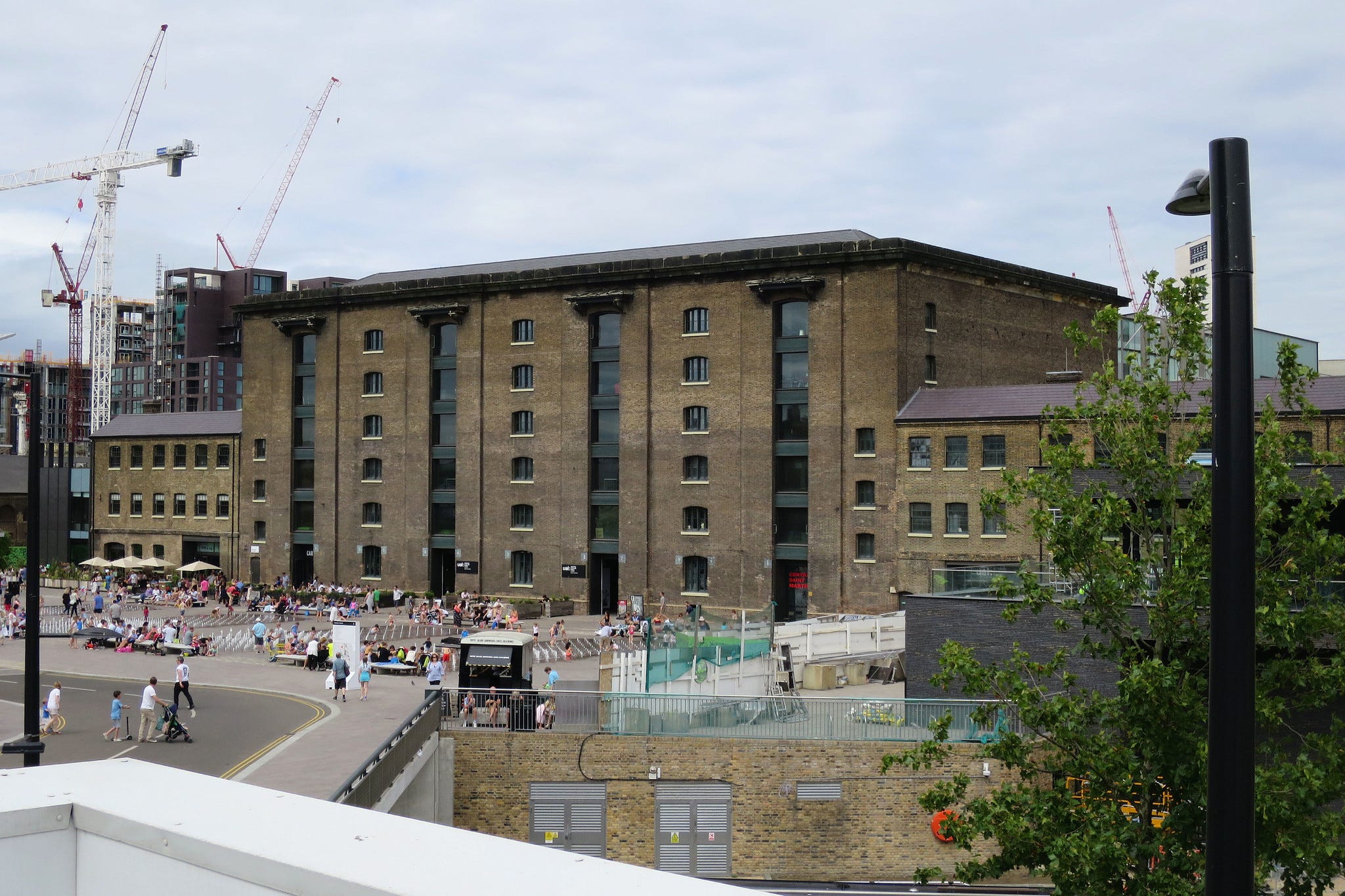
Ten minutes down the road, near King’s Cross, is Granary Square, the result of a regeneration project in the area. Outside the new Central St Martins campus is a large square full of fountains, through which young children run on hot days. There is space to picnic, open-air markets, and the space hosts public screenings of events like Wimbledon.
Finsbury Park is publicly owned and open to the public. Granary Square is a bit different: it is open to the public, but the entire development is privately owned. To almost everyone, it looks and feels like public space, but it operates by different rules. The development corporation that owns the land can set additional rules, and exclude whoever it wishes.
True public spaces are owned by the public and maintained solely for our enjoyment and benefit. Quasi-public spaces look and feel the same, but they’re run with a different motive in mind – they’re made nice for us so as to generate profit for their owners. It’s a means to an end, rather than the point of the exercise. Most of the time, the difference between the two is invisible, but that doesn’t make it any the less important.
Private spaces, public consequences
What does any of it have to do with the internet, though? Well, let’s think through what happens when things go wrong with our real-world public spaces. Let us imagine Finsbury Park or Granary Square full of discarded rubbish, perhaps even including chemicals or broken glass. Picture it no longer policed, so that muggers or worse patrol it without fear of consequences. Imagine either full of drug addicts, leaving discarded hypodermic needles scattered around.
It is fair to say that few of us would want to let our children play in such neglected and dangerous public spaces. Whether they were still open or not, parents would surely stop taking their young children there, and they would warn their older teenagers against going there at once. Parents would not need to wait for their governments to order them to do so.
But similarly, no citizen would let a public space in that state of disrepair continue to operate. It doesn’t matter that Granary Square is privately owned – that doesn’t mean the laws of the land don’t apply there. It can set additional rules of its own, but every law that applies to a public park is in force there, too.
This is not a concept we find difficult or confusing in the offline world. But for some reason, we find the same ideas much more challenging in the online space. There are almost no truly public spaces on the internet. Everywhere we congregate is privately owned, even if it operates as a public space. But we seem somehow content to accept them as fiefdoms in their own right, beyond the reach of government. Instead of demanding that they function as safe and pleasant public spaces for all of us, we are asking our governments just to ban teenagers from them.
The UK government has lots of powers to govern the internet that it simply isn’t using. Hosting images of child abuse is a strict liability offence, one that Elon Musk’s X platform blatantly breached with its Grok chatbot. The government gave itself extensive powers to regulate social platforms under the Online Safety Act, which it has never even made an attempt to enforce.
Doing so might be politically difficult – the US government has made it clear it regards attempts to govern online spaces as “censorship”, or an intrusion against US interests – but governments are there for the hard jobs, and there was never an agreement to give the US sovereignty over the internet. We are still inside UK borders when we use the internet. The infrastructure is here. The revenue is made here. The internet is eminently governable.
Teenage trespassers
It is one thing to ban our children from one park when there are others nearby. It is quite another to ban them from every public space when there are no others on offer. In the 21st century, life is lived online – adults of all ages socialise through the internet, we get our information from it, we learn from it, and we rely on it for vital services.
What does it mean to ban someone from a social network? Is YouTube a social network? How about WhatsApp? Most modern games include social features. If social networks are strictly defined by a ban, teenagers will simply migrate to any one of dozens of other online services with similar features. If it is broadly defined, we will effectively ban a generation from the internet.
Adolescence is supposed to be when we pick up the skills to handle the world in adulthood. We socialise outside of the sight of our parents, we push our boundaries, we explore the world. An effective social media ban would dump hundreds of thousands of 16- or 18-year-olds onto the internet without any learning curve, without any time to have learned how to navigate it with adult supervision and safety wheels. All of that is before we consider the economic damage of raising an offline generation in a global economy reliant on the internet.
In practice, of course, a social media ban would be widely circumvented. If we think the internet is bad for teenagers now, imagine a world in which all online access is illicit. Social platforms would have a new defence against online harms against that group: they’re just not meant to be there.
Provided Facebook, X, TikTok or whoever could show it had some legally compliant age verification system, harm befalling a teenager wouldn’t be their fault. They weren’t supposed to be there, after all. Instead of being the negligent owners of a space marketed to teens, they’re the blameless victims of trespass.
A teenage social media ban is the digital equivalent of seeing our parks full of needles, broken glass, and violent thugs – and deciding that a “KEEP OUT IF YOU’RE UNDER 18” sign stuck on the entrance is enough.
A bad space is better than no space?
A necessary caveat on this argument: I am skeptical as to whether social media is as dangerous as some of its critics say. I am even more skeptical as to whether it is particularly dangerous to teens and young people. Evidence suggests polarisation and radicalisation – and susceptibility to mis- and disinformation – affect all ages, not just young people. Some studies suggest digitally native young people are better inoculated against some online harms than older adults.
I don’t intend to relitigate what is a years-long discourse with no shortage of studies which seem to evidence any argument you would wish to make. Jonathan Haidt is the best-known advocate of the case for the prosecution, while Pete Etchells’ book sets out the argument for caution.
The central facet of my argument in this post is that wherever you land on the matters of the harms of social media, a ban for teenagers is the wrong response. If the harms are overstated, the policy is unnecessary. If they are not, it is an abdication.
It is not the duty of government to abandon online territory, to cede it as ungovernable. It is the duty of the government to provide safe public spaces, both online and offline. Children need those on the internet just as much as they need them in their neighbourhood. It is on all of us to make sure we can provide them.
To see the government pick a fight with Elon Musk would be very encouraging; I suppose that's one reason why I don't expect it to happen. But you have persuaded me that it needs to. If we don't want to be governed by foreign oligarchs — we are going to have to fight them off. Pre-emptive cringing won't help us.
Britain is powerless against the tech companies unless it bands together wirh other countries like the EU